Twenty-Five (Mostly) Terrible Ideas to Fix America’s Debt Problem
Read at Your Own Peril

It is July 15th. At the stroke of 11:59 PM ET, the Boyd Institute will close its highly anticipated essay contest soliciting heterodox solutions to resolving America’s looming debt crisis.
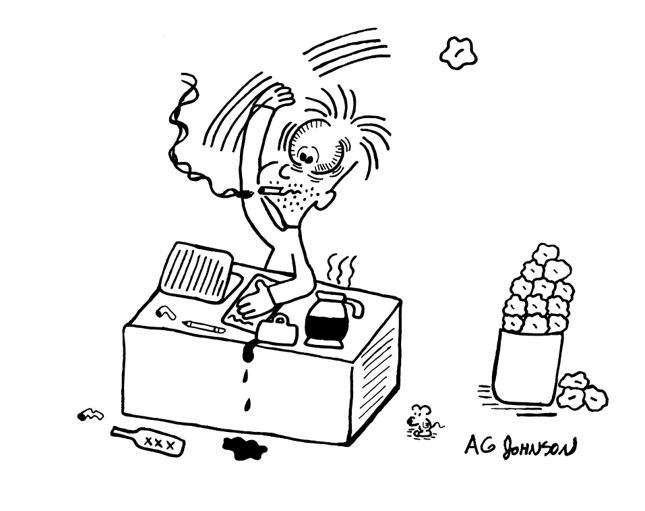
I spent the past several months slavishly researching and drafting a 1,000 page tome documenting innovative and highly technical solutions to America’s debt crisis, replete with copious detailed footnotes, charts, ampersands, and iambic pentameters. Unfortunately, this morning I realized that for all these months I had been typing my detailed findings on a dead laptop. Due to my monomaniacal devotion to aiding the Boyd Institute’s noble mission, I had not bothered to look up from my (now mysteriously missing) notes and observe the inert computer screen. Shucks.
As such, I do not have much to offer for this esteemed contest. The Boyd boys have assured me that whatever I have to offer will be welcomed; I have made it my mission to test this assurance. In the proud tradition of Thomas Edison and Nicolas Cage, I will be throwing a bunch of ideas against the wall and seeing what sticks. Most of them will be terrible, while a couple might be realistically achievable. This essay will not by any means win the Boyd Institute’s contest, but it will serve an honorable purpose by making everyone else’s look better by comparison.
But first, some background.

***
At this point in our nation’s history, neither party can be trusted to exercise unchecked power on behalf of reducing the federal deficit. Democrats have one deficit reduction lever that appeals to them: taxes. If left to their own devices, Democrats would enact a barrage of new federal taxes aimed at the deficit. Unfortunately, though, anyone who knows anything about Democrats recognizes that the vast majority of this tax haul would be diverted to myriad new entitlement program expansions, largely counterbalancing any fiscal improvement. Republicans are no better. While the GOP was plausibly serious about entitlement reform between 2010 and 2016, this era ended with Donald Trump’s 2016 primary victory. Most Republicans in Congress undoubtedly continue to support something comparable to the Path to Prosperity budget, which passed the Republican-led U.S. House multiple times in the early 2010s, but likely not at the margins necessary for passage, even with Republican majorities in both chambers.
While neither party is incentivized to place the country before short-term political interests, a critical mass of responsible legislators from each party might forge an ugly compromise that forces both parties to share equal blame, mitigating if not neutralizing the advantage of recalcitrance on any agreement reining in profligacy. Should this occur, it will probably take the form of a “grand bargain” similar to the famously unsuccessful National Commission on Fiscal Responsibility and Reform (Simpson-Bowles) debt commission from 2010. Thanks to the continued fecklessness of our nation’s political leadership, Simpson-Bowles 2.0 would require far larger tax increases and spending cuts than its predecessor and would have to withstand a political climate that is much more hostile to entitlement reform than that in 2010. Yet, reviving a more aggressive version of a failed debt commission proposal amidst greater political resistance is still, sadly, the most realistic path forward.
***
Because technocratic bipartisan deficit commissions are kind of boring, though, allow me to indulge in twenty-five mostly terrible deficit reduction solutions instead:

Congress could make Ozempic free for all Americans, helping to bend the health care cost curve and reducing Medicare, Medicaid, and ACA health care exchange spending.
The franchise might be deprived from those dependent on public assistance, including Social Security and Medicare, allowing Congress to undertake bold entitlement reform without suffering electoral consequences.
A Canadian-style Medical Aid in Dying (MAID) assisted suicide program could be subsidized and incentivized for use among the nation’s elderly.
The Federal Reserve can order trillion-dollar coins to be minted ad infinitum, tanking its credibility and spiking inflation, yet reducing the magnitude of the national debt.
All U.S. debt could be transferred to a U.S. territory, such as American Samoa or the Northern Mariana Islands, or an uninhabited territory such as Navassa Island or Wake Island (or even our nation’s largest territory, the moon). After transferring our national debt, said territory would be granted national independence, after which it could default on its (our) debt while America becomes debt-free for the first time since Andrew Jackson.
A Constitutional amendment overruling Clinton v. City of New York and granting a presidential line-item veto power could be ratified, permitting the president to veto specific budget items within mammoth spending bills while approving the remainder. This power, in addition to being possessed by forty-four out of our nation’s fifty governors, was also formerly held by Jefferson Davis under the Constitution of the Confederate States of America. As for the wording of this Constitutional amendment, I recommend pilfering the text used by the Confederate Constitution (thanks, Robert Barnwell Rhett): “The President may approve any appropriation and disapprove any other appropriation in the same bill. In such case he shall, in signing the bill, designate the appropriations disapproved; and shall return a copy of such appropriations, with his objections, to the House in which the bill shall have originated; and the same proceedings shall then be had as in case of other bills disapproved by the President.”
The Supreme Court of the United States could invalidate the Constitution (and, by implication, itself), thus reinstating the Articles of Confederation, on the basis that the Philadelphia Convention’s adoption of the U.S. Constitution did not meet the state unanimity requirement for amendments to the Articles of Confederation. Doing so will trigger an automatic and drastic reduction in the size and scope of the federal government, due to its significantly more limited authority under the Articles of Confederation. It would also eliminate the federal taxing power, trigger a major Constitutional crisis, and precipitate perhaps the largest short-term economic meltdown in global history, but we can cross those bridges when we come to them.
A Constitutional amendment that permits secret roll call votes for budgets may be ratified, enabling legislators to do the right thing for the country without, per usual, being punished for it.
Congress could repeal the laws of economics.
The 60-vote cloture rule could be eliminated for all bills that result in a net reduction in the federal budget deficit over a ten-year timeframe. This would permit Congress to enact an unlimited number of annual bills conforming to reconciliation rules, up from one under current law.
Cancel the Harry Potter HBO reboot series.(Note: Good idea, but off topic.)Congress could quietly repeal the FICA income tax cap, thereby bolstering payroll tax revenue, while massively reducing other taxes, which would mechanically rebuild the Social Security trust fund without increasing the aggregate level of taxation. In doing so, the role of intragovernmental Treasury securities derived from SSA surpluses would increase as a share of total federal debt, even as repayment of these securities is postponed indefinitely due to said surplus. This could, in the short term, help insulate the U.S. from foreign creditors while it continues to splurge, as long as the motivations of Congress are disguised enough to avoid spooking the bond market. (Note: I may be completely misunderstanding how U.S. intragovernmental debt even works, so this is probably dumb on multiple levels.)
America could invent time travel and use it to prevent LBJ from ever entering politics, saving the United States trillions in national debt accumulation.
The U.S. could utilize AI to effectively adopt zero-based budgeting, though this would resemble DOGE’s ill-fated efforts.
Congress could sell off Wisconsin to private interests intent on using it as the world’s foremost landfill and nuclear waste site
as punishment for Wisconsinites’ smug sense of superiority ever since Minnesota politics went insaneas a means of bringing in leasing revenue.
Congress could establish that budget allocations for all line items within appropriations bills represent the maximum that may be spent on these line items, rather than a fixed total. This might encourage thrift within the executive branch, which will no longer feel compelled to spend every appropriated dime within the fiscal year, if cheaper means are found to comply with statutory requirements. There is precedent for this in American history. In fact, the presidential impoundment power, in which presidents would refuse to spend appropriated Congressional funds (now significantly curtailed by the Impoundment Control Act of 1974), appears to have originated from the way early appropriations bills were drafted. Most line items of early U.S. appropriations bills authorize the executive branch to spend “a sum not exceeding” the amount allocated by Congress, thus embedding and incentivizing a mechanism for deficit reduction into the executive branch of the United States. (Note: I have not been able to find sources that explicitly support my claim about the origin of the impoundment power, but I am about 98% certain that I am right.)
We could do… this. We used to think big as a country.
America could annex the rest of the planet before either defaulting on our debt or coercing the rest of the world to service it, thereby preventing capital flight.
America could alternatively nuke the entire planet except itself.(Note: This proposal would not properly uphold America’s humanitarian values, and it would upset anime fans.)Congress could enact, and states could ratify, a balanced budget amendment that provides significant yet enforceable constraints on federal deficits. A modified version of the proposed 1995 balanced budget amendment, the iteration that came closest to passage in Congress (clearing the two-thirds threshold in the House but failing by a single vote in the Senate), would likely be the most practical form that this proposal could take. This modified version could be worded as follows:
Section 1. Total outlays for any fiscal year shall not exceed total receipts for that fiscal year, unless three-fifths of the whole number of each House of Congress shall provide by law for a specific excess of outlays over receipts by a rollcall vote.
Section 2. The limit on the debt of the United States held by the public shall not be increased, unless three-fifths of the whole number of each House shall provide by law for such an increase by a rollcall vote.
Section 3. Prior to each fiscal year, the President shall transmit to the Congress a proposed budget for the United States Government for that fiscal year, in which total outlays do not exceed total receipts.
Section 4. The Congress may waive the provisions of this article for any fiscal year in which a Congressional declaration of war is in effect.
Section 5. The Congress shall enforce and implement this article by appropriate legislation, which may rely on estimates of outlays and receipts.
Section 6. Total receipts shall include all receipts of the United States Government except those derived from borrowing. Total outlays shall include all outlays of the United States Government except for those for repayment of debt principal.
Section 7. This article shall take effect beginning with the second fiscal year beginning after its ratification.
America could declare Chapter 11 managed bankruptcy, placing judges and Chinese creditors in charge of reorganizing and managing our finances.

We could bet everything on AI.
We could bet everything on Elon Musk mining asteroids.
We could bet everything on the second coming of Jesus Christ.

We could bet everything on Yellowstone’s supervolcano rendering civilization nonviable and budgetary concerns trivial by comparison.
Fixing America’s stark budgetary challenges requires thoughtful, intelligent, and deliberate analysis… but I hope you unlucky readers enjoyed this blather anyway.

The secret roll call vote idea could lead to some really interesting outcomes from a game-theoretic perspective. If voters had no real way to know if their representatives were voting in accordance with their preferences, politicians would have two options:
1. Moderate-maxxing, where they run only on positions likely to please the broadest constituencies so voters can never assume that their representatives are responsible for an unpopular passage/failure
2. Partisan-maxxing, where the politicians outwardly present themselves as so fanatical and rigid that their constituents would trust that they indeed would be voting as advertised. However, despite their outward displays, the partisan-maxxers would be free to vote however they please -- even at the opposite extreme of what they advertise
For voters, their only recourse when faced with a Congress who displeases them is to assume the incumbent is a defector and vote for challengers until things get better, whereas presently most voters continue to return incumbents to their seats and hope the few swing seats in the nation go their way. Thus you could end up with a high-turnover legislature highly incentivized to take whatever actions they can in their brief window of authority and not at all disincentivized by political pressure
Copy the Canadian health care system. The aggregate savings exceed the budget deficit by almost a trillion dollars per year (not to mention full coverage, no medical bankruptcies, and better health outcomes). Raise taxes in a sensible way to cover for the fact that not all US health coverage is currently paid by the government (this could be done so that no one’s tax rise exceeds their health care savings, but I’d prefer to target some exemptions like carried interest and stepped up basis on death). Of course this will never get past the health insurance lobby, but plenty of these ideas are even less realistic or cost effective!